
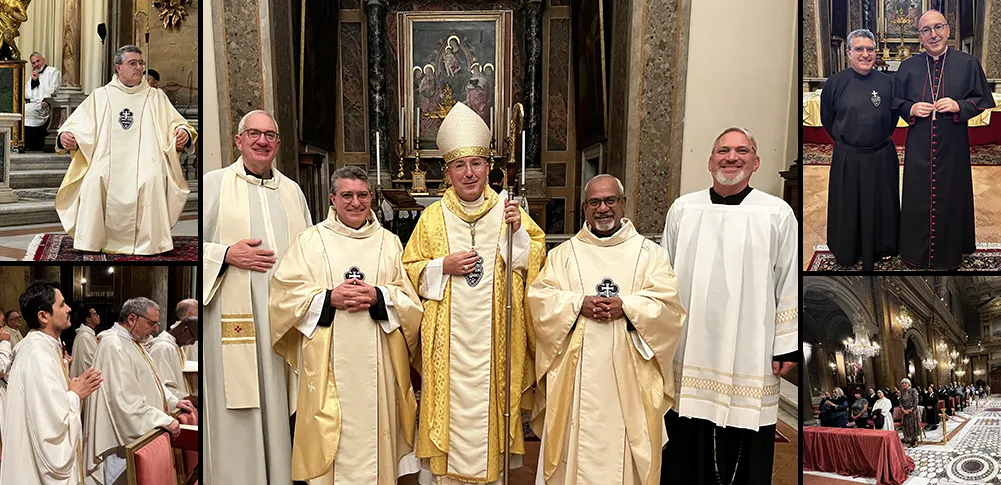
Below is the full text of the homily of Msgr. Mauro Lalli.
+M. Lalli – 19/10/2026
Basilica of Saints John and Paul on the Caelian Hill
Very Reverend Superior General of the Congregation of the Passionists,
Reverend Passionist Sisters and Religious,
Dear brothers and sisters,
we celebrate the Feast of Saint Paul of the Cross, an apostle of the Passion of Christ, whose life and teachings, although matured in times different from our own, have much to say to us and to our world.
A few days ago, in the homily read by Cardinal Luis Antonio Tagle during the Holy Mass for the tenth anniversary of Amoris laetitia, the Holy Father reminded us that “domestic charity […] is the first school of affection, the first precious and irreplaceable apprenticeship in the ‘joy of love’” (October 14, 2026). I would therefore like to mention, first of all, the soil in which the seed of Saint Paul’s vocation took root: the family.
The great thanksgiving we raise to the Lord thus begins in the small town of Ovada, in the province of Alessandria, and in a modest, ordinary family setting, noble not so much in lineage as in the Christian values it lived.
Saint Paul himself would say that it was in that environment that he began to “taste the love of God”, finding within the walls of his home, especially in his bond with his mother and with his brother John Baptist, the flame of a sincere and devout faith from which to kindle his youthful enthusiasms: first the dream of becoming a soldier, then the growing awareness that he was destined, in God’s plans, for another army and for higher and more decisive battles.
It was in that climate of humble and solid piety, and of strong, healthy ideals, that a pairing sprouted in his soul which would accompany him throughout his life: the silent contemplation of God’s love and the courageous impulse of prophecy.
And it was there that the mystery of the Cross, “foolishness to those who are perishing, but to those who are being saved […] the power of God” (1 Cor 1:18), began to penetrate ever more deeply into his personal existence as a boy, a young man and an adult, through inspirations, joys and sufferings, but above all thanks to a constant recollection before God, pondering all things (cf. Lk 2:19) and making them an instrument of discernment and illumination.
Among the symbolic places of this search we can count the “little cell of San Carlo” in Castellazzo Bormida, where in hermit-like solitude he wrote the Rules of the future Congregation, and Monte Argentario, the first convent of the fraternity.
These places, however, recall a space that is more important, an interior one, which Saint Paul learned to frequent within himself from childhood and in which, as the years went by, he strove ever more habitually to dwell.
It is the hidden “cell” in which he learned to read and make his own, with ever greater clarity and concreteness, the signs of the Passion, which he then translated into the symbols that characterize you: the nails of tribulation, the laurel of victories, the olive branch of peace, the heart and the cross, expressions of gift and sacrifice, the white and the black, images of the lights and shadows of existence.
Of all this, Saint Paul, with the help of the Spirit, made a synthesis deep within himself, until he matured and embraced the mission of “promoting […] the continual and devout memory of the life-giving Passion and Death of Jesus Christ” (Rule of 1775, Chapter XXXIV), understood and proclaimed as the “greatest and most stupendous work of divine love” (Letters II, 499).
He thus devoted himself to proclaiming with his life what the liturgy led us to pray in the Responsorial Psalm: blessed be the Lord whose love is “from everlasting” and “to everlasting” (cf. Ps 103:1,17). In the Crucified One, Saint Paul recognized above all the great sign of God’s faithful love, experienced in so many moments of his life, proclaimed in his preaching, and now entrusted to you, religious of the Congregation of the Passion of Jesus and members of the great Passionist Family.
He taught us that the Cross is not the memory of a distant event, but a present gift of grace and charity at work within us, the only way through which, in the Pasch of the Son of God made man, who died and rose for our salvation, our existence finds meaning, fullness and fulfillment.
Dear friends, never as today, in a world that in many ways is ostentatiously indifferent and distant from the Lord, yet for that very reason even more in need of light and hope, is it necessary to meditate on and spread the message of the Passion, bearing strong witness to what we heard in the Gospel: “whoever wishes to save his life will lose it, but whoever loses his life for my sake will find it” (Mt 16:25).
Only love saves: God’s love for us and, in Him, our love for one another. Pope Leo XIV reaffirmed this in the Encyclical Letter Magnifica humanitas when, referring precisely to the Passion of Christ, he wrote that “the future of humanity finds […] its criterion in the capacity to welcome this divine way of drawing near, of sharing the weight of the world, of transforming relationships from within” (232).
For you, Passionists, this mission passes first of all through the offering and the witness of your Consecration, to which it is important that you renew your attachment and dedication every day, in prayer, in community life and in fraternal charity, as Saint Paul himself recommended to you in his spiritual Testament.
Your charism is the Cross, and therefore the love that neither calculates nor measures. Saint John Paul II expressed this very well in a Message addressed to you, saying that your task in the Church is to love: “to love where it is most difficult to love; to love where love is most needed” (Message to the Superior General of the Passionists, August 25, 2000). Pope Francis, years later, reaffirmed the same thought, calling you “prophets of the love of the Crucified in a world that is losing the sense of love” (Message on the occasion of the Jubilee Celebrations for the Third Centenary of the Congregation, October 15, 2020).
And it is very beautiful to hear the echo of this pairing of love and prophecy in the theme you chose for the meeting of young Passionists, held here in Rome last summer. It reads: “Charism that unites, mission that sends” and, in light of what has been said, we could easily replace the word “charism” with the word “love”. “Love that unites, mission that sends”, because, as your motto says: “may the Passion of Jesus Christ [the full revelation of the Father’s charity] be always in our hearts” and in the heart of every person.
Dear Passionist Fathers, I wish to renew to you, with deep esteem, the exhortation addressed to you by Pope Benedict XVI: to guard and constantly rekindle in your hearts and in your ministry “la memoria passionis Christi”.
Pope Benedict wrote in his Message to the General Chapter of the Passionists in 2006: “Your Founder was intimately convinced that the evils of the world derive from forgetfulness of the Passion of Jesus: for this reason, his unceasing longing was to remember and to invite others to remember the Passion” (Benedict XVI, Message signed by Cardinal Tarcisio Bertone to the Participants in the General Chapter of the Passionists, October 5, 2006).
Reverend Fathers, as I renew my most heartfelt thanks for your kind invitation, I wish to offer a wish that draws directly from the source of your charism.
I join in spirit the wish that the holy founder Paul of the Cross addressed to Sr. Colomba Gertrude Gandolfi in the context of their rich spiritual correspondence, where he meditated mystically on the mystery of “death in pure love”: “May Jesus Crucified be always in [your] heart, to make [you] saints with the hidden holiness of the Cross. Amen!”
