
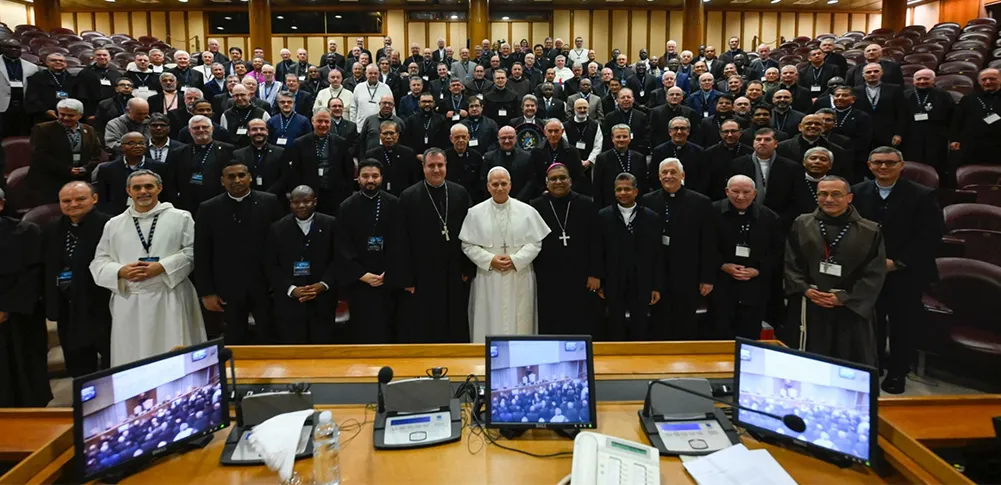
MEETING WITH POPE LEO XIV
USG General Assembly
26/11/2025
RESPONSES OF THE HOLY FATHER TO QUESTIONS FROM THE USG SUPERIORS
1. Holy Father, what essential contribution do you expect from consecrated life for the mission of the Church today?
Pope Leo XIV
I mentioned this in point two of my speech. I would like to underline perhaps two aspects of
Partly of what I've expressed, but certainly of what I think is not only essential, but I think
what the world is looking for and the world needs today. The first area is precisely that of our
consecration of religious who are called to be witness to the presence of God in the world, to
be a message of a spiritual life which invites people to look beyond what is immediate in a
world where many of you work which people that has become so secularized and seem to
have difficulty making a connection and discovering once again the spiritual dimension of their
lives, in spite of the fact that they feel that hunger. Which is so apparent especially in young
people, but also in so many people. And I think that the witness of consecrated life has a great
deal to offer to the Church and to the world.
And the other point is precisely in the midst of the challenges of this digital technological
world that we're living in, the importance of human relationships, of coming together, not
through a screen, but to be with one another in person and how important personal
relationships are in terms of developing those dimensions of human life. That of course enters
into culture and education and again the spiritual realm of all these dimensions that make up
part of who we are as human beings. I think that precisely members of consecrated life are
called in one way or another to live the witness of community life that can offer great service
to the world through our living faithfully in that dimension.
2. How can we fully live synodality and collegiality in the Church, valuing cultural diversity and renewing our relationships with bishops?
Pope Leo XIV
I'll start with the last point. Which should be the easiest answer, but it's the most difficult to
live perhaps for some of you. Living synodality with bishops. As you know one of the study
groups that was formed after the synod of Synodality 2023-2024 was precisely on Mutue
Relationes, which I think began with the idea that we need to write a new document. In fact,
it has developed, with time, into an understanding that we have to develop a new way of
relating within the church consecrated life with the hierarchy, with bishops, working not
separately from one another but together with authentic harmony and communion.
Despite the differences that may exist, we can really come together to serve the whole people
of God. There's no need to tell stories about how it doesn't work. It would be better to tell
stories of how it does work and why it's important. And on that level I think that synodality as
both an attitude and as an instrument could help bring us together bishops, members of
Consecrated Life and Laity, to speak with one another, to listen to one another, and to search
together for what is best for the church through the gifts that each person and each
community has been given. The witness of consecrated life, because of the tradition which
most of our congregations and orders have had for so many years and even centuries, is very
important. For instance, chapters, and living the dimension of dialogue and understanding
and looking together for solutions to the challenges that are before us.
I think that's a marvelous example of synodality. It can also be of service to the Church
somehow to bring those different pieces together. As consecrated men and with consecrated
women in the church in which we're living, I think we'll offer a great service, indeed to the
Universal Church and to the local Church.
3. What guidelines can you indicate for the formation of young religious and for strengthening community life in the new challenges of our time?
Pope Leo XIV
I think that this is a very important question for several reasons, especially in those parts of
the world where our communities are challenged to find vocations. You may find in some of
your communities, monasteries, provinces, regions, a situation where you might have only
one student in formation, maybe two. In that case, to create an environment and the culture
of formation is a real challenge, when you don't have the basic elements necessary to create
the environment to form a new member for communal and consecrated life. So that we end
up sometimes forming in individualism because perhaps there's only one candidate. And so
the great challenge for formation, is giving greater emphasis to participating in
intercongregational formation experiences, in having a greater number of encounters with
other members of the congregation or order. It may not be people in formation, but for
example with the younger members of a community or congregation who could be of closer
support in a positive way to those who are in formation.
Another important issue is that there are still today groups that do not pay attention to so
many guidelines that have been given about receiving people into formation that have been
sent out of other formation houses or other seminaries. The Dycastery for clergy that are
casting for consecrated life to see all the problems that there are because people started off
on the wrong. It's wonderful that someone says he has a vocation. But part of our role is
discernment. And that discernment for the good of the Church means we can't accept
everyone who knocks at the door. And we have to be very serious about that. Oftentimes that
very first step was ignored.
One other aspect which I would like to specifically mention is what I would call formation in
freedom or liberty. A true formation, a healthy formation, I think, needs to accompany the
young candidates who come to us, so that they first become healthy human beings. There are
a number of modern movements which under the guise of being traditional or conservative,
take in young people and oblige them to fit into a mold and say if you do this you will be a
good candidate. Sometimes we're repeating the same errors that were committed many years
ago, and they're coming back to haunt us. Instead of being able to develop first as a human
being and understand what human freedom is, we are sometimes forming young people in a
situation where we oblige them under conscience, we remove their freedom, we make them
feel guilty if they say, well I don't think I have a vocation. We sometimes put obligations on
young people that are not healthy. Our formation, especially in the first stages, really needs
to be to form people to become true human beings with the gifts that God has given them
and to see how the Lord is calling them through those gifts, not through the mold that we're
forcing them to fit into. There are real challenges in that. I'm sure many of you have been
formators and understand that, but again nowadays I think a lot of people in religious life and
in seminaries have forgotten the lessons learned in the past. So it's very important for our
formation that we form healthy human beings who then with that health of uh their own
humanity discover how God is working in their lives and how God is calling them to give those
gifts to the Church to service.
4. How can consecrated persons bear witness to human dignity and Christian humanism in the age of artificial intelligence?
Pope Leo XIV
I think this is one of the questions that we really need to study and reflect upon and look for
answers. Artificial intelligence, we're just at the dawn of whatever that means. And I think the
world is discovering more and more both the potential and also some of the risks involved in
terms of what artificial intelligence is and can become. Certainly one aspect that I think is
important is that the human dimension has to be primary. We, as human beings, can be
helped by artificial intelligence. But if the trends continue some people are raising concerns
that human beings will be serving artificial intelligence, and I think that would be a big
problem. The challenges is how to develop in a healthy way the gift that artificial intelligence
can be, but to define those ethical guidelines that will accompany the people who use it so
that it won't take over the role of what humanity needs to preserve the value and the dignity
of human life.
5. Holy Father, in what specific ways can religious institutes contribute to building peaceful relations within the Church and throughout the world?
Pope Leo XIV
Becoming true peacemakers, I believe, is a great challenge for the Church and especially for
religious life. For all of you who bear witness with your lives and who, through teaching,
preaching and other ministries, live the values of the Gospel, I believe that today it is necessary
to promote those methods that help us understand what peace is and how to achieve
authentic peace, which often means preaching a message of justice. Because in many parts of
the world where there are conflicts today, it is precisely because of the injustices that exist.
And I think that our role has a very important element, it is a very important element in terms
of building peace in our communities, starting most of the time at the local level. It is not a
theoretical thing. Some may write beautiful treatises on peace and say many fine words, but
what matters is living peace. One of the gifts that religious life can offer, in terms of meaning,
is to bear witness that we can live together and show that it is possible to overcome divisions
and differences, and bring people together to live a peaceful and harmonious life, particularly
in those congregations or orders that are able to bring together international communities
made up of people of different cultures, mentalities and languages. This is an expression of
our humanity, but through it the presence of the divine among us is expressed. And this can
be a great witness to the world today. So I think that in these specific ways each of our
communities can truly become a true peacemaker.
6. What message of hope would you like to entrust to religious men and women today for the journey of the Church and the world?
Pope Leo XIV
The message of hope must always begin and end in Jesus Christ. And we must not be afraid
to proclaim the Gospel. Hope is not optimism. They are not the same thing. There may be
people who, by nature or personality, are always very optimistic, but sometimes optimism can
also be something superficial. Discovering the true source of hope is something very different
that comes from the gift of faith, from a deep relationship with Jesus Christ that leads us to
proclaim our trust in Christ with authenticity, even in very difficult, very painful, very dark
situations. A few days ago, I listened to a person who has spent years and years of his life in
prison. And he will probably spend the rest of his life in prison. He says that he experienced a
true conversion in prison and today he feels more hopeful and freer than ever in his life. This
is because he has discovered that source of life and hope that is Jesus Christ. Our spiritual life
cannot be superficial and limited to performing certain acts, but must be deeply rooted in
Jesus Christ, in the Gospel, in a personal relationship with Christ: this is perhaps the best
message we can convey and that you can convey in the face of all the challenges and
difficulties we have in today's world.
In the Middle East, religious life is called to be a beacon of hope and a bridge of dialogue. What vision and fundamental priority does Your Holiness indicate for consecrated life in order to renew its mission and the formation of consecrated persons capable of authentic dialogue with other Christian confessions and with Islam?
Pope Leo XIV
True dialogue begins with dialogue among ourselves, which arises from each person's
personal dialogue with God and thus enables us to engage in true dialogue with the brothers
with whom we live. It always makes me think deeply when I see a young priest who decides
to leave his religious community to become incardinated in a diocese. When asked why he is
doing this, he replies that he felt a loneliness in the community that he could not heal,
overcome, or remedy. And so he thinks that the solution is to go to a diocese and live in a
different style. It is true that many times even in our communities members say they feel
lonely. We must ask ourselves if in our communities we are really just functionaries doing a
job (one is a math professor, another does this or that), because we have not really learned
to form a community of fraternal life and communion. When our communities are truly well
formed and the brothers live in loving communion, then they can give a very beautiful
message to others, both for ecumenical and interreligious dialogue. I have been blessed to
know the witness of Christian communities in countries where the vast majority are of another
religion and the Christian community is not there to proselytize. Surely many of you have had
this experience. In these contexts, the witness of the community is the most important step
in building bridges based on respect for the dignity of others, on the willingness to listen, to
receive, to accompany, and to walk together. Communities that offer support for health,
schooling, education, or other forms of charity and hospitality: their presence and their
service are already a very important witness. This is how it becomes possible to create an
environment, a culture of dialogue and respect for dignity, which in itself is already a big step
forward in building a human community in peace and dialogue among brothers and sisters.
USG President Fr. Arturo Sosa
LWe are deeply grateful to you for the time you are dedicating to us while you should be packing your bags for your trip to Turkey and Lebanon. Thank you very much for reminding us of the essential points of being religious because, if we do not live them, whatever we do is useless and does not correspond to what we profess.
Pope Leo XIV
Let us pray together for a moment and ask for the Lord's blessing for each of you. Thank you also for all your service.
