
Translated into English with AI
Original article from Vatican News https://www.vaticannews.va/es/iglesia/news/2026-11/iglesia-mision.html
Missionary in the Peruvian Amazon: being present, accompanying, listening and celebrating the faith
From Lagunas, in the Peruvian Amazon, Passionist priest Miguel Ángel Marugán accompanies native communities and populations marked by poverty and isolation. After almost eleven years of mission in the rainforest, he shares his experience of self-giving and closeness to those who suffer most.
Sr. María del Pino Rodríguez de Rivera Olives – Vatican City
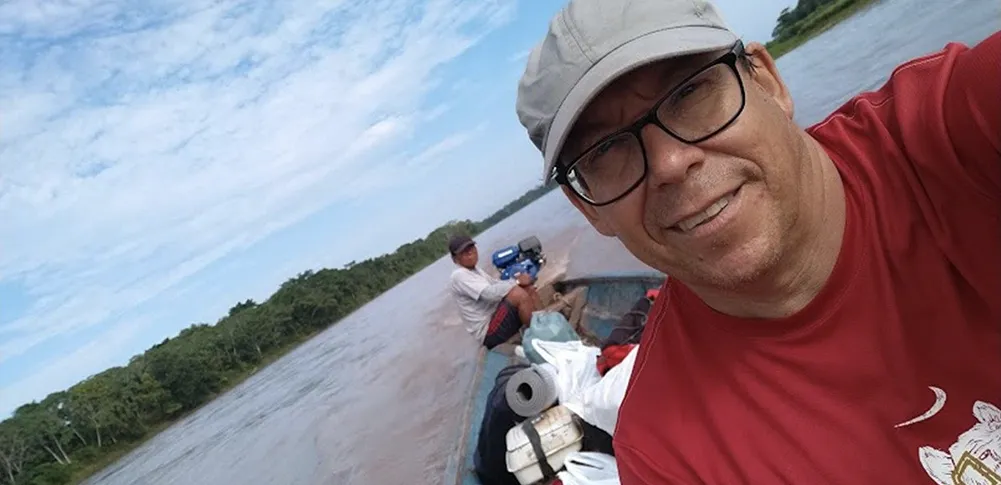
Miguel Ángel’s missionary work takes shape in visits to communities that can only be reached by river, some of them after several days of travel by boat. There, his mission is to be present, to accompany, to listen and to celebrate the faith, but also to respond to people’s most basic needs. In the context of Pope Leo XIV’s apostolic visit to Peru, Father Miguel Ángel reflects on the importance of giving visibility to the most forgotten populations and of strengthening a Church that is close to those who live on the peripheries. He is convinced that his task is to be a bearer of hope and to remind people that God forgets no one.
Mission in the Peruvian Amazon is marked by great distances, hard-to-reach communities and social realities that call for a close and committed presence of the Church. In this interview, the Passionist missionary introduces us to his experience in Lagunas, where the proclamation of the Gospel becomes life through accompaniment, listening and service to the most vulnerable.
Missionary experience and the Passionist charism
“My name is Miguel Ángel Marugán López, and I am a Passionist missionary and priest. I was born in Madrid and now I live in Lagunas, a little corner of the Peruvian Amazon. Lagunas belongs to the Apostolic Vicariate of Yurimaguas, in eastern Peru. It is a district of the Province of Alto Amazonas, in the department of Loreto. My parish, “María Inmaculada Concepción” in Lagunas, lies on the banks of the Huallaga River, shortly before it flows into the Marañón. It includes Lagunas, with about 8,000 inhabitants, and 50 native communities (of the Kukama Kukamiria and Quechua peoples) scattered along the various rivers of the area, with another 7,000 inhabitants. My parish and my communities can only be reached by river. There are no roads or paths, only rivers and more rivers, and this also makes communications very difficult. I belong to the Passionist community of Yurimaguas, made up of 7 missionaries. Although I am alone at the mission post of Lagunas (about 6 hours by river from Yurimaguas), we work united in prayer and always in solidarity.”
As a missionary who shares the life and mission of the Church in the Peruvian rainforest: how long have you been there and what has your missionary experience been like over these years? How is the Passionist charism embodied in the social, cultural and ecclesial reality you find in the country?
I have been in the Peruvian rainforest for almost 11 years. At the beginning of 2016 I was assigned to Yurimaguas, where I spent 4 years in the rural communities of the area. There I looked after an itinerant parish, the “Buena Noticia” parish. In 2020 I arrived in Lagunas, the mission post where I have now been for 7 years. Here I accompany the community on its journey of faith and in the thousand and one needs there are, of every kind: economic, educational, health, accompaniment… and spiritual too.
I came to Peru after almost 20 years of work in a Passionist school, the “San Gabriel” school in Alcalá de Henares. For me it was a cultural, emotional and spiritual shock, and I thank God for it as an opportunity to renew and rejuvenate my Passionist charism.
Here we can truly say that our Passionist charism “becomes flesh”: it is embodied in every single reality we live. I arrived in Lagunas a few months before the COVID pandemic. The chapels were closed, but God willed that we reach every corner of the parish bringing aid, food and then medicine. The churches closed and the little houses and hearts opened.
I came to know a different Lagunas, going from house to house, visiting the sick, putting myself at the service of the people. Since then my work and my commitment have been the pastoral care of all the people of Lagunas and its communities. I visit them at least once a year, given the great distances or, better said, the difficulties of access. To give an example, it takes me 3 full days by boat to reach the most distant community of my parish, travelling 12 or 13 hours a day. When I set out on a missionary journey, I spend 3 to 4 weeks on the boat, visiting the native communities of the Nucuray River, the Pavayacu River and the Marañón River. And I do this several times a year.
It is in those simple communities and in the neighbourhoods and informal settlements of Lagunas that you find the clearest and most vivid faces of a Church with an Amazonian face, as Pope Francis told us. It is a population with great cultural richness, but also with extreme economic and social poverty. Access to education and healthcare is minimal, and shortages of every kind put trust in institutions to the test. On the other hand, all this makes me feel more Passionist among so many crucified people. It has given me the confidence to see these brothers and sisters of the rainforest as part of God’s chosen ones, even if, sadly, they are also those forgotten by men.
Community of Lagunas, Peru
Mission day by day
From this experience and this way of living the charism, how does your mission take shape day by day? Which people and which realities challenge you in particular, and what do you try to offer them through your missionary vocation?
My mission here is “to be present”, “to accompany”, “to listen” and also “to celebrate the faith”. I must say, however, that what people appreciate most about missionaries is feeling welcomed and listened to: in a few words, cared for and loved.
Our parish is simple and always has its door open, and I mean that literally. Every day many people come to ask for advice on all kinds of situations. Many are looking for help with food to feed their little children, others come for all sorts of paperwork: identity cards (DNI), social programmes, etc.
Besides being a Passionist missionary, I am also a social worker, and I put my enthusiasm into it both as a professional and as a missionary. I know well that we will not change reality. But we all know how important and healing it is to meet people along the way who, even if they cannot solve our problems, pass on trust and hope to us. I believe that my work and my mission here, among the simple people of Lagunas, is precisely this: to be a bearer of Hope. I want to be able to tell people that, even if they think they are forgotten by everyone, God does not forget them; on the contrary, He loves them, and very much. I want to tell them that the Catholic Church will always be at their side in the struggles and toils of every day. And that, even if the reality they have been given has deprived them of everything, the doors of God’s heart are open to them.
The visit of Pope Leo XIV
In recent days Peru has been preparing to welcome the visit of Pope Leo XIV, a particularly significant event for the Church and for the country. How are you living and preparing for Pope Leo XIV’s visit to Peru in the coming days? What do you expect from this encounter and what do you think it can offer to the Church and to Peruvian society, from your perspective as a missionary?
In these very remote places the Pope’s visit certainly goes somewhat unnoticed… (bear in mind that in the native communities we visit there is no electricity, no internet, no communications). And yet for us missionaries, knowing that the Pope is “very close” to us is a true moment of Grace. We also have the joy of knowing that Leo XIV knows the reality of this great country, Peru, very well, and that he carries us in his heart and in his prayers.
Within our small means, we are helping the children, young people and adults of Lagunas to get to know our beloved Pope a little better. We want them to feel and know that the Pope thinks of them and will always be at their side.
Above all, I hope that this apostolic journey of Leo XIV to Peru will revitalise the faith of a very religious country. As is happening all over the world, however, Peru too is slowly drifting away from God, dazzled by what consumer society sells us as ideals. I also hope that it will “shake up”, in a certain sense, our leaders, so that they do not forget the most remote and forgotten populations of Peru, among them the native peoples, the inhabitants of the rainforest.
Finally, I hope that in the Church we may feel more united with, and identified with, the many crucified people who walk beside us. That we may feel the need to walk together in building the Kingdom of God among us. And that the spirit of synodality that has arisen in the Church may become flesh in the realities that best represent our true identity and the meaning of being Christians.
