
The Cross as Theological Language:
Spiritual Convergences between John Henry Newman and Domenico Barberi
by Maurizio Buioni, CP
Introduction
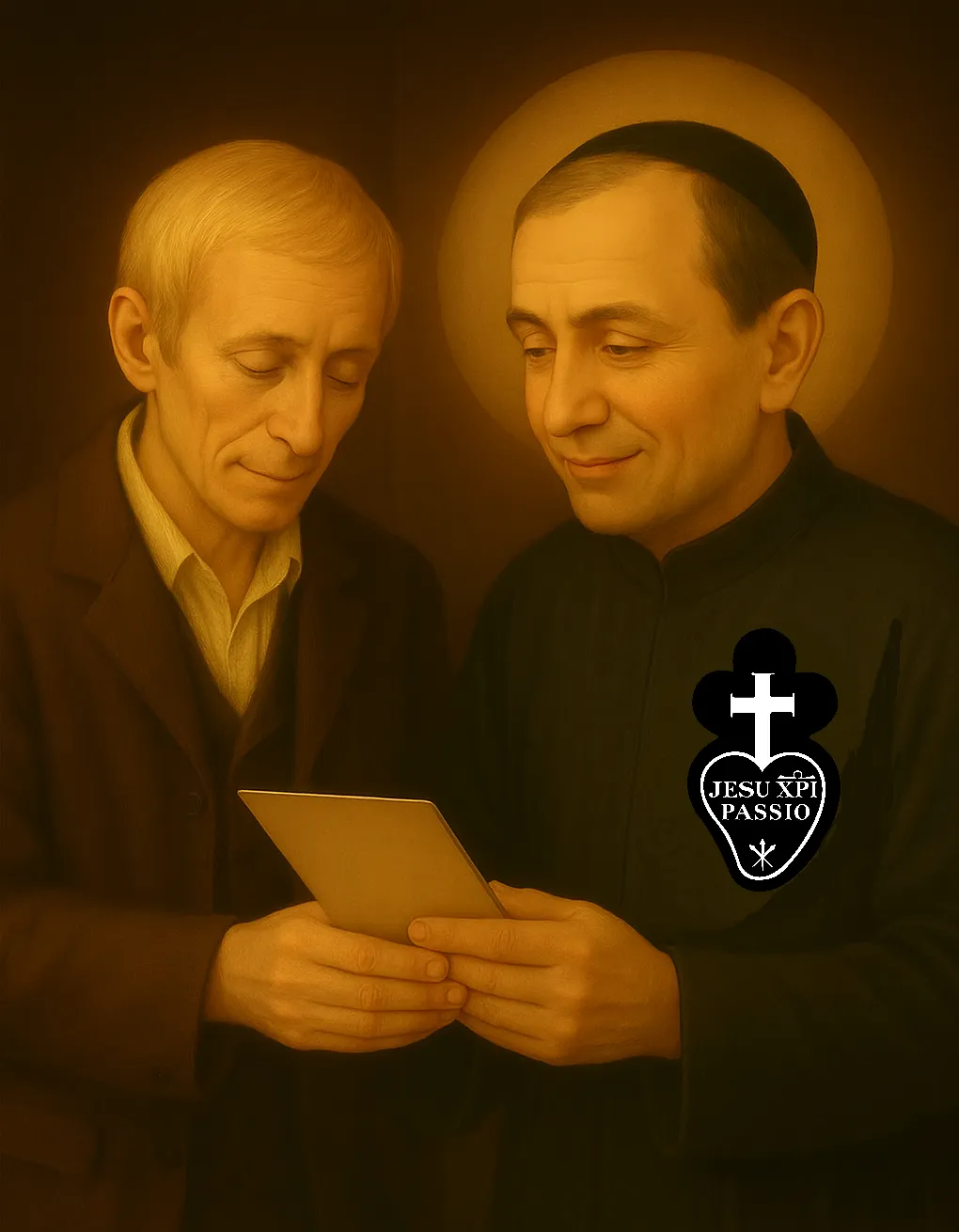 The Cross, the central mystery of Christian faith, traverses the centuries as theological language, grammar of love, and prophetic sacrament. This study analyzes the spiritual convergence between John Henry Newman and Blessed Domenico of the Mother of God (Barberi), with particular attention to the Cross of Christ as hermeneutic key, epistemic principle, and shared theological locus. In a time marked by ecclesial transitions and doctrinal polarizations, the witness of these two protagonists emerges as a living response to the crisis of meaning and identity fragmentation. Their theology is mystical, lived, redemptive, and finds in suffering its central paradigm (von Balthasar, Theo-Drama, Jaca Book, 2005, vol. II, pp. 67–75).
1. Biographical and Spiritual Profile of Newman
John Henry Newman was born in 1801 and raised in an Anglican environment. He was a key figure in the Oxford Movement, aimed at rediscovering Patristic and sacramental Tradition (Ker, John Henry Newman: A Biography, Oxford University Press, 1988, pp. 55–89). His conversion to Catholicism in 1845, sacramentally received by Blessed Domenico Barberi, marked a spiritual and theological turning point. The gesture was more than personal—it was an ecclesial icon (Barberi, Spiritual Writings, Edizioni Passio, 1958, pp. 130–136). For Newman, conscience is “the first Vicar of Christ” (Letter to the Duke of Norfolk, Longmans, Green & Co., 1875, p. 68). Suffering becomes a path to truth and purification (Sermons on Subjects of the Day, Longmans, Green & Co., 1869, pp. 225–231). With the Birmingham Oratory, he united community and thought, proposing an integrated education (The Idea of a University, Longmans, Green & Co., 1873, pp. 23–39). His canonization in 2019 and proclamation as Doctor of the Church in 2025 by Pope Leo XIV seal the universal and prophetic value of his theology.
2. The Cross of Christ in Newman’s Thought
The Cross is a soteriological center and epistemic principle: “To suffer is to learn what we are and what God is” (Apologia Pro Vita Sua, Longmans, Green & Co., 1864, p. 248). It is revelation of divine love and pedagogy of conscience (Parochial and Plain Sermons, vol. VI, 1869, pp. 117–124). His “descending” theology of the Cross anticipates similar visions in Bonhoeffer (The Cost of Discipleship, Queriniana, 2010, pp. 56–63) and von Balthasar (The Heart of the World, Jaca Book, 1980, pp. 141–155). Newman sees the Cross as generative principle of the Church, source of Tradition, and criterion for communal discernment (On Consulting the Faithful in Matters of Doctrine, 1859, pp. 45–51).
3. Life and Mission of Blessed Domenico Barberi
Domenico Barberi was born in 1792 and embraced the Passionist spirituality inherited from St. Paul of the Cross. He received a vision calling him to evangelize England, facing cultural opposition and religious indifference (Moreschini, The Heart of the Cross, Edizioni OCD, 2009, pp. 43–66). His spirituality is kenotic, mystical, prophetic, expressed in the sign of the pierced heart—pedagogy of grace and love (Barberi, Spiritual Writings, 1958, p. 133). His sacramental gesture toward Newman represents an ecclesial event, symbol of spiritual unity among Christian confessions (Tagliaferri, Barberi and Newman, Studium, 1965, pp. 83–95). His beatification in 1963 confirms his missionary and prophetic charism (Holy See, Beatification Decree, LEV, 1963).
4. Theological Convergences: A Mystical and Ecclesial Synthesis
The Cross is for both the organizing principle of theology. In Newman, it illuminates conscience and Tradition (Parochial and Plain Sermons, vol. VI, 1869, p. 117); in Barberi, it is incarnate sacrament of grace and prophetic proclamation (Spiritual Writings, 1958, p. 133). Von Balthasar affirms: “The Cross shapes intelligence, not just the heart” (Glory, Jaca Book, vol. I, 2000, pp. 74–82). Congar reiterates: “True reform passes through Golgotha” (True and False Reform in the Church, Queriniana, 1972, p. 218). Moltmann describes it as revelatory principle and foundation of Christian ecumenism (The Crucified God, Queriniana, 1973, pp. 114–121). The theological synthesis between Newman and Barberi is mystical, ecclesial, and missionary: capable of envisioning the Church as wounded body and place of redemptive reconciliation.
Conclusion
The Cross is not the end—but the beginning. Not silence—but living Word. Not condemnation—but grammar of redemptive love. In Newman, the Cross transfigures thought and conscience. In Barberi, it shapes mission and witness. In their encounter, the Cross becomes ecclesial event, prophetic sacrament, gesture of spiritual unity. Newman’s proclamation as Doctor of the Church in 2025 by Pope Leo XIV is recognition of a theology that bows before Mystery and speaks with depth. Barberi’s beatification celebrates not an apostle of success, but an evangelizer of suffering. In an ecclesial time marked by ideologies and fragmentation, the Cross returns as primary language, revelatory principle, and disarmed force capable of conversion. This redeemed, humble, and paschal theology teaches us that the Church is not born of perfection, but of shared wounds. Newman and Barberi offer us a path: that of the Cross lived, contemplated, incarnated. A way back to the roots of Christianity. A theology that embraces pain, the poverty of language, and the depth of silence. A theology unafraid of the Cross—because it was born from it.